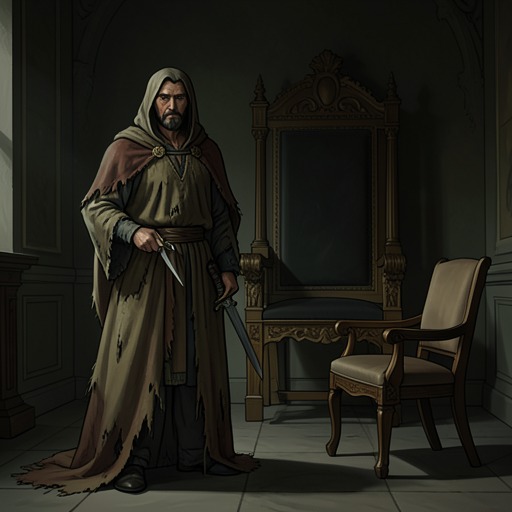
Darilth–Keralth rivalry
The Vampire Prince’s BrideDarilth–Keralth rivalry is presented as both a contest within the Rothgar royal family and a struggle over what the Drakonaar court considers worthy of succession. When Darilth brings Ella before his father, King Rezelith, he finds Keralth already occupying the favored position beside the throne. Rezelith’s approval of Keralth and his contempt for Darilth’s human true mate make the rivalry inseparable from the court’s judgment of blood, strength, and political usefulness.
Rival Princes at the Rothgar Court
Darilth and Keralth appear together in the throne room of Rothgar Castle, a severe space of dark stone, armed guards, and windows opening onto an almost entirely frozen world. Darilth stands before his father as the prince who has returned with the woman he believes is destined to become his bride. Keralth, by contrast, is already beside Rezelith, dressed in dark clothing similar to Darilth’s and accompanied by a beautiful but visibly drained mate. Their physical placement establishes a hierarchy before either brother speaks: Keralth is close to the king, while Darilth must advance into judgment.
Darilth formally introduces Ella as his true mate and asks his father to recognize her. The request is more than a family announcement. Ella’s acceptance would validate Darilth’s choice and strengthen his place within the royal line; rejection would leave both his bond and his political standing exposed. Keralth does not need to make an open challenge in this moment. His presence beside Rezelith, and the king’s readiness to use him as a standard against Darilth, allow the rivalry to operate through comparison.
Rezelith’s Favoritism and the Insult to Ella
Rezelith refuses to reconsider Darilth’s claim. He points to Keralth as the successful example, praising him for having found his mate long ago and describing that mate as intelligent, strong, trained for battle, and warrior-like. The king’s approval is qualified only by the fact that Keralth’s mate could not awaken the stone, yet even that limitation does not prevent her from serving as the measure by which Ella is condemned.
The comparison becomes an attack on Darilth’s identity as a prince. Rezelith calls Ella weak because she is human and tells Darilth that he could learn from Keralth. In doing so, the king converts Keralth’s relationship into evidence of superior judgment while treating Darilth’s true-mate bond as proof of political and martial failure. Keralth’s smug smile confirms that the comparison benefits him, even though the scene does not show him making a formal claim or directly arguing with his brother.
Personal Hostility Beneath Dynastic Competition
Darilth’s response reveals how quickly the political rivalry becomes physical and personal. As Keralth looks at Ella with a smirk, Darilth wants to strike him in the face. The impulse is restrained, but it exposes the violence beneath the court’s formal language. Darilth is not merely defending a romantic attachment; he is reacting to Keralth’s apparent enjoyment of Ella’s humiliation and to the possibility that his brother’s favored status will be used to erase Darilth’s own legitimacy.
Rezelith’s judgment deepens the conflict by making paternal recognition conditional on conformity to the court’s ideals. Darilth sees no kindness in his father’s eyes, not even toward his own son, and interprets Rezelith’s emotional coldness as a change associated with the death of Darilth’s mother. The rivalry with Keralth therefore unfolds inside a damaged father-son relationship: Keralth is elevated as the model son, while Darilth experiences the king’s decision as a rejection of both his mate and himself.
Consequences for Darilth and Ella
After dismissing Darilth, Rezelith leaves the prince with no public victory. Darilth bows, takes Ella by the arm, and escorts her from the throne room. Ella cries as they leave, fearing that the hostile Drakonaar may treat her as a slave or kill her. The rivalry’s immediate consequence is thus not only Darilth’s loss of face but Ella’s increased vulnerability within the royal household.
Darilth’s anger continues after the audience. His grip tightens as Ella pleads with him, and he nearly drags her back to his chambers before loosening his hold and turning her toward him. The scene shows how the king’s decision and Keralth’s smug presence have transferred courtly humiliation into the couple’s private space. Darilth’s struggle is now double: he must oppose the authority that rejected Ella while also preventing his own fury from becoming another form of coercion.
Narrative Significance
The rivalry establishes Keralth as the visible embodiment of the standard Rezelith imposes on Darilth: an approved prince, a warrior household, and a relationship that appears compatible with royal expectations. Darilth represents the opposite possibility, in which a true-mate bond with a human challenges the court’s hierarchy of species and strength. Because Rezelith openly invokes Keralth to discredit Darilth, the brothers’ conflict is not an isolated personal dislike but a dynastic dispute structured by the king’s favoritism.
At this stage, the evidence supports a rivalry marked by proximity, comparison, contempt, and threatened violence rather than a completed confrontation between the brothers. Keralth’s role is powerful precisely because he can remain beside the throne while Darilth and Ella are sent away. The scene turns the frozen court into a political image of their relationship: Keralth stands within the king’s circle, while Darilth leaves carrying the consequences of choosing a mate the ruling family refuses to honor.